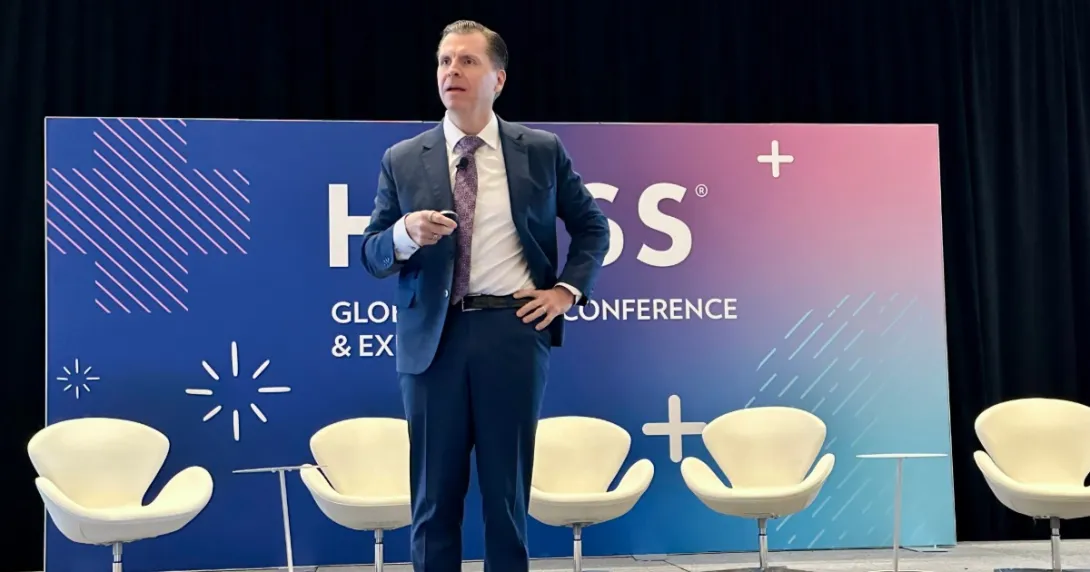
Dan Liljenquist, chief strategy officer at Intermountain Health
Photo courtesy of Nathan Eddy
LAS VEGAS – Healthcare systems facing mounting workforce shortages and rising demand must rethink how they use data, Dan Liljenquist, chief strategy officer at Intermountain Health, said during his keynote on AI and interoperability at the 2026 HIMSS Global Health Conference & Exposition here today.
Liljenquist argued that many organizations still treat both capabilities as technical requirements rather than strategic tools that could reshape care delivery.
The urgency stems from demographic and workforce pressures already straining the U.S. healthcare system. As the population ages and clinicians leave the workforce, existing operational models are becoming harder to sustain.
"The biggest challenge is the health system we have today is not equipped to survive," Liljenquist said, noting that traditional workflows and technologies were designed for a very different era of care delivery.
For Intermountain Health – a nonprofit system that operates 34 hospitals across six states with nearly 70,000 employees – the response has been to elevate interoperability and AI to the center of its long-term strategy.
Liljenquist said two forces are creating an opportunity for change: growing regulatory momentum around health data exchange and rapid advances in artificial intelligence.
"We have a regulatory body right now – CMS – that is finally awake to this issue and trying to move us into a new future built around data interoperability," he said. "The other tailwind is technology advancement using primarily artificial intelligence."
But achieving meaningful interoperability requires more than simply enabling data exchange through APIs or standards such as FHIR.
Liljenquist emphasized the need for what he described as "computable data" – information that is standardized, structured and usable across systems without extensive manual cleanup.
"You can have a FHIR standard, and you can have data transfers," he said. "But when that data comes through, you still have to manually clean that data up."
Intermountain Health is attempting to address that problem by building a unified data layer in the cloud that extracts data from electronic health record systems and standardizes it using common semantic models.
The organization is uploading large volumes of EHR data into a cloud environment each day, then organizing and normalizing it so AI systems can analyze it consistently.
"The biggest challenge in healthcare is spending $750 billion a year on administration because our data is such a mess," Liljenquist said. "If we want to have the resources in the future for care, we have to reduce that by hundreds of billions of dollars."
The goal is to create a foundation where AI can support clinical decisions, automate administrative tasks and improve population health management at scale.
"We must have a consistent data model," he said. "There is nowhere else to go to change the trajectory of where we are going."
Liljenquist pointed to the potential for AI-driven medication management and earlier intervention in chronic conditions as examples of how interoperable data and AI could change care delivery.
Ultimately, he argued, healthcare organizations must stop viewing interoperability as a compliance exercise and start treating it as a strategic platform.
"AI and interoperability are not technical problems," Liljenquist said. "They are strategic problems. They are the strategic engine for future healthcare."